Tuesday, September 29, 2009

Banquets, Banquets, Banquets!

At the end of the last year we never managed to have the traditional end of the year banquet so this semester Ken has been bugging Baker, the communist party person in charge of the English department, to get us a banquet. Banquets are more than just a social function for having fun with colleagues and friends they are all about hierarchy and jobs. Baker as essentially the highest ranking person at most of our banquets is in charge of doing most of the toasting. He moved from Baijou to beer pretty fast and we were all giving him shit about it but with the number of toasts he raised I think he'd have passed out on the table had he been drinking liquor the whole time. His assistant who wants to move up to his job some day was also making the rounds toasting everyone he could. It's basically a sign of importance to toast people all around the table. It's hard to know what Baker's position is relative to the non-part head of the English department since as she is a women she doesn't participate in most of the whole toasting culture. At the banquet when all the Chinese teachers started smoking I went up to my room at got a big cigar I had left over from the US and brought it back down. All the Chinese people were pretty interested in it especially two Japanese teachers who happened to be at the banquet.

Monday, September 28, 2009

Lobster Fest Changzhou


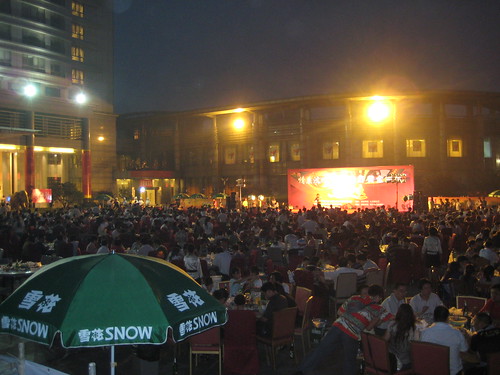
All through my year at the hotel I'd seen posters for a big festival that seemed to be out in the parking lot. I always assumed that it was something they had done for the opening of the hotel not some repeating thing. The one day I noticed that they had begun to set up about 60 tables out in what was usually the parking lot right in front of the hotel. I didn't even know about it until it was already underway but it seems that at some point every year they have a big lobster, or more accurately cray fish, festival. They set up for some huge number of people and then serve what I believe are all you can eat cray fish. Besides all the food they set up a huge stage where there were all sorts of activities. I saw what looked like a beer drinking contest and they had acrobats and marshal art demonstrators. They also had the guy in the video below, assuming I can ever upload it, who is playing the hell out of some traditional Chinese instrument. I couldn't get a great view from the lobby of the hotel so I cirlced around to a wall behind all the action which actually was already packed with other looky loos who were all really interested to see some American there as well.


Sunday, September 27, 2009

Mall of China


Before I came home I needed to go shopping for some presents to bring to people. There are a lot of stores around the main mall but they're pretty much exclusively clothing stores and they can be a little pricey. There is also in a different area of downtown Changzhou a mall called Lu Qiao. Lu Qiao is a mall in the Asian sense which is completely different from anything we have in America. The whole place, which is the size of a regular mall in America across five different floors, is filled to the brim with individual stalls selling all manor of things. It's sort of like an outdoor market which you see in some places but the whole thing is under one gigantic roof. The stalls aren't always separated by walls like in a real store some are just divided by sheets thrown up all over the place. The mall sells about anything you can find in China. The whole first floor is only cloths and me and Carrie spent a lot of time walking around buying people t-shirts with funny badly written English on them. The next floor was all luggage for some reason. The floor above that was all shoes where I was able to find some of the squeaky shoes that I've seen children wearing which sound like a dog toy with each step.

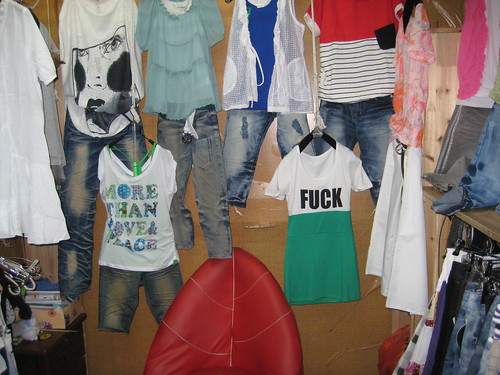
The floor above that was jewelry. On the top floor was anything that didn't belong on one of the previous floors including all sorts of traditional style masks and combs and what not. Me and Carrie spent a lot of time wandering around buying lots of different stuff. In Lu Qiao everything has to be negotiated for and my lack of Chinese puts me at a huge disadvantage which is why I was so grateful that Carrie came along. By far the most effective negotiating position was to walk away. Basically no matter what the person said in about 20 seconds we would look disinterested and start to wander over to another booth, that'd be when the price would mysteriously be cut by half. Without Carrie there to conduct most of the negotiations there's no telling how much I would have paid. The oddest thing in the whole place was a dress which was a nice normal dress except for the work FUCK written across it in large black block letters. I took a picture of it and couldn't contain my laughing. In retrospect I wish I would have told them what it meat to see what there reaction would be. There's no way that they would have knowingly put a shirt like that on display for everyone to see. I hope it's still there.

Saturday, September 26, 2009

Prisoner of the State


I recently finished reading the book "Prisoner of the State" by Zhao Ziyang. Zhao was one of the most important premiers of China during the early days of opening up after Mao's death and from '87-'89 he was General Secretary of the Communist Party, which is the top job today held by Hu Jintao, but at the time he was still second to Deng Xiaoping, the paramount leader until his death. Zhao spent most of his career in Beijing as the top lieutenant of Deng Xiaoping in charge of economic reforms, which basically meant transforming China from a planned economy to a capitalist one. He was General Secretary when the June 4th Tienanmen Square protests began and it was his unwillingness to send in the army after the students which lead to him being forced out of the party and spending the rest of his life under house arrest. During his time under house arrest he secretly made tapes of his thoughts on the days leading up to the Tienanmen Square Massacre, his time trying to run the economy of China, and the future of China. I would highly recommend he book to anyone with any interest in China. The inner workings of the party are so opaque and the history of China so rarely told accurately that this book is of immense importance.

There were a few things that he talked about that I thought were really interesting. First there is some interesting stuff about why capitalism is better than communism, which he actually provides with some really simple examples. He talks about how under the old system farmers were all forced to grow basic food stuffs, but when he liberalized it somewhat some farmers could turn to growing cash crops which grew better in there area. The value of the cash crops was such that they could be sold for much more basic foods then the farmers would ever have been able to grow. He also paints himself as having been even more than Deng Xiaoping the person pushing for the early move towards capitalism. People in China just have no sense of who he was since he's been essentially erased from the history books. Next he talks about something which I had been saying also for a while. He notes that while some people saw the growing problem of corruption as a problem with capitalism it was really a problem with the dictatorial nature of the government. If the government perceives any complaints as anti-government than people can never point out corruption. Zhao ran into a lot of problems with the fact that people had no way to tell anyone interested in stopping corruption who was corrupt.

Finally near the end of the book Zhao talks about how he believes that the only way for China to continue forward both with economy and politics is to adopt a more western style of government including a real multiparty democracy. He writes here near the end of the book, "I once believed that people were the masters if their own affairs not in the parliamentary democracies of the developed nations in the West, but only in the Soviet and socialist nations' systems with a people's congress, making the latter system more advanced and a better-realized form of democracy. This, in fact, is not the case. The democratic systems of out socialist nations are all just superficial; they are not systems in which the people are in charge, but rather are ruled by a few or even a single person." It may not be anything earth shattering to say the communist countries aren't really for the people but it's not every day that a former General Secretary of the Chinese Communist Party says it. The last really interesting thing is the black and white picture I have in this post. The figure in the center with the bullhorn is Zhao here appearing in Tienanmen Square, after he was essentially forced out of power and only hours before the tanks would come rolling in, pleading with the students to leave. He said that while it was too late for him and too late for the protest that they were young and should still leave while they could. Standing just to the right of him and looking directly into the camera is Wen Jiabao the current Primer of China who worked under Zhao at the time. What is really clear from the book is that the legacy of that fateful day changed forever the course of Chinese history.
Friday, September 25, 2009

Chinese High School

Now I never really liked English corner that much. I just don't know what to say when everyone is all grouped up around me and looking at me. But one of the few interesting topics that comes up from time to time is what high school was like for Chinese students. I always see the college here as so restrictive with so many mandatory activities and a set bedtime but compared to what they all go through in high school I see why they think it is so liberal. Not every year of their education is as bad as the last few but by the time they get closer to taking the college entrance test, which is basically the only thing that determines what college they go to, high school is basically a 24/7 thing. The stories differ a little from person to person but the basic times and outline is pretty consistent. They usually wake up some time between 5-6 am, i.e. just when the sun is coming up, to start their first classes. The first class period or two actually takes place before breakfast. Sometimes this is a real class sometimes it's essentially a study period. After that is breakfast which is about 30 minutes long at most. Then the morning classes begin which are a series of classes held in the same room with the same group of students where the teachers just rotate.

These also aren't the worlds most engaging classes as they are almost all just lectures where the students take endless notes. After morning classes there is lunch time. Lunch time lasts about two hours but most of that time is spent napping since they barely got any sleep last night. After nap time are the afternoon classes which go until about five or six at night following the same format as the morning classes. Next is dinner time. Some students who live close to the school, a lot live in the school dorms, go home for their meals but it means they have less time for napping. After lunch are evening classes. These either go to about eight and then the students have a bunch of homework, or they go until ten or eleven in which case there was some time during the day to do homework. When they get back to the dorms they have between half an hour and an hour to get ready for bed. Then it's lights off. Not only are they made to go to bed but people walk around and make sure they're sleeping and not talking. So basically during the last two years or so of high school every single hour that's not spent in school is spent eating or sleeping. They also have either only one day off a week or none at all. Some high schools actually only give about one day off a month. When I first heard all this my reaction was that I'd never have made it. I think it would be better to take up a life of crime. What are they going to do after all execute you, at least that doesn't take 16 hours a day every day.

Thursday, September 24, 2009

Gone Fishin'


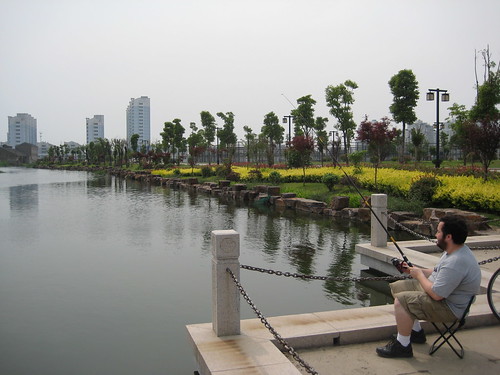
All around the back of the campus are some little canals that are there mostly for show. Changzhou used to be on the grand canal, the one from Hangzhou to Beijing, but that's long past. Out of the back of the campus is a new large canal that seems to be used for actual industrial traffic but the little canals around the city and the campus are just for looks. It seems weird to say they're there for looks since they all look like shit, or more aptly sewage. They are always brown or really dark green and while they do move slowly they also don't exactly smell spring fresh. That is of course why I decided to go fishing in one of them. I often think that the only thing I really do for the students here is to challenge their perceptions, and since no one would ever think of fishing in the canal that's why I did it. I had expressed this idea to Dave and he relayed it to an old Chinese guy he had befriended. The old guy knew where a fishing store was and I went over there with him and Dave. They had a pretty big selection of fishing poles and I bought a pretty basic collapsible one which along with line, hooks, weights, worms, and a really small chair came to about $17. The hooks and weights were oddly designed so that instead of casting it you just lowered it into the water and waited for some fish. I'd seen Chinese people doing this but it just didn't appeal to me.

When I got home I took off the hook and weight system they had put on and just attached a basic hook and some weight. Now for one thing I don't know much about fishing, and for another I don't know anything about tying knots so that I'm not sure the thing I came up with would ever have been able to catch a fish. Of course that wasn't much of a problem since there is no way there were any fish living in the water I was fishing in. It's not just the pollution, fish can live in some pretty murky water it's that I don't think the canal I was in actually connected to much of anything besides some pipes. But the point wasn't to catch fish it was just to fish, so one sunny afternoon Dave and I headed out to the canal to try our luck. Just as I was hoping there were a lot of odd looks and some concerned questions from the people passing us by. Catch and release must not be a Chinese thing since people were all relived when I told them I wasn't planning on eating anything I caught. The person who spent the most time watching us was a worker or gardener who was taking a break. He was wearing the perfect fishing hat but I wasn't quite sure how to ask to borrow it. Eventually I realized though the biggest flaw in my plan, I don't like fishing. I got bored pretty quick and after there weren't many students left I gave up, though I did catch a nice piece of some weed. Now the fishing pole sit mounted on my wall since there's never going to be a fish there.
Wednesday, September 23, 2009

Front Row


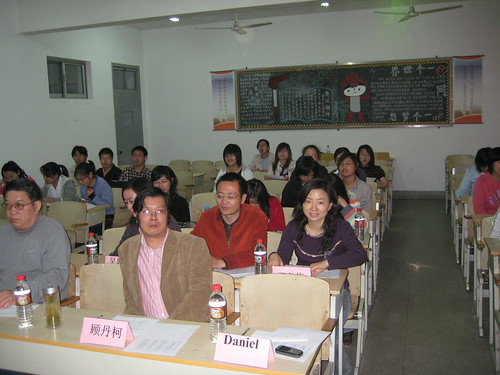
I judged another speech competition before I left for Korea and while this one was basically the same as the other ones I had judged, terrified students reading canned speeches, there are two things I want to share. The first is this photo which shows all six of the judges, or at least in my case my name card. I was sitting in the front row next to a guy who used to be the dean of some department but essentially retired, or was forced out depending on who you ask, but still retains a lot of his pay and status, and the only full professor in the English department. In the back row was Steve with two other teachers. It's just still odd that I have more status as some foreigner with no experience then Steve who's been a teacher for a long time and is, you know, a professional. The former Dean also seemed to have little interest in actually listening to anything that was being said and instead just wrote little notes to me asking me where I was from and what not. With all you hear about Chinese modernization foreigners are still a rare commodity. Also this time I took a video of the competition so you dear reader could get some idea of what judging it is like.